

Environmental Protection
Greenhouse Gas Emissions and Management
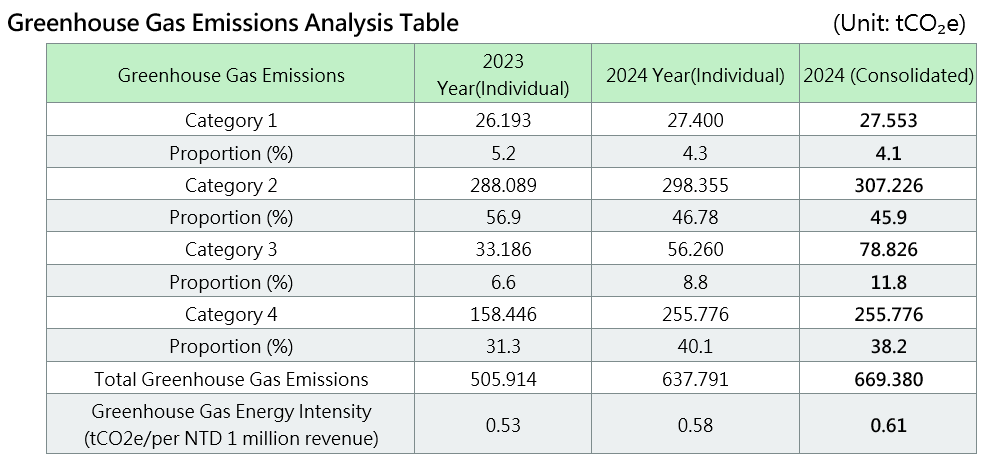
To enhance risk assessment and management, inergy Technology will conduct a GHG inventory in ISO 14064-1:2018 in 2023, with third-party verification in 2024. 2023 will be the base year for its inventory convering direct GHG emissions (Category 1), purchased electricity (Category 2), upstream transportation (Category 3), and raw material purchases and wastes (Category 4). This inventory will be updated annually, and the improvement targets will be based on annual reviews.
| GHG Emissions Per Year |
Category 1 (Unit:tCO2e) |
Category 2 (Unit:tCO2e) |
Category 3 (Unit:tCO2e) |
Category 4 (Unit:tCO2e) |
Total (Unit:tCO2e) |
External Assurance Provider | Description of Assurance Engagement | Assurance Opinion / Conclusion | Verification or Assurance Certificate |
|---|---|---|---|---|---|---|---|---|---|
| 2025 | 157.7201 | 353.4794 | 76.0262 | 525.0380 | 1,112.2637 | KPMG | ISO14064-1:2018 ISAE 3410 Reasonable Assurance Standard |
Category 1 and Category 2 — Reasonable Assurance Category 3 and Category 4 — Limited Assurance |
Download |
| 2024 | 27.553 | 307.226 | 78.826 | 255.776 | 669.380 | KPMG | ISO14064-1:2018 ISAE 3410 Reasonable Assurance Standard |
Category 1 and Category 2 — Reasonable Assurance Category 3 and Category 4 — Limited Assurance |
Download |
| 2023 (with 3rd party verification) |
26.1926 | 288.0890 | 33.1864 | 158.4455 | 505.914 | UCS (Universal Certification Service Co., Ltd.) | ISO 14064-3:2019 CNS 14064-3:2022 Reasonable Assurance Standard |
Scope 1 & 2 Reasonable Assurance Level Scope 3 Limited Assurance Level |
Download |
| 2022 | 35.0697 | 315.3872 | 4.2139 | 1.373 | 357.444 | - | - | - | - |
Energy Efficiency
Energy Intensity
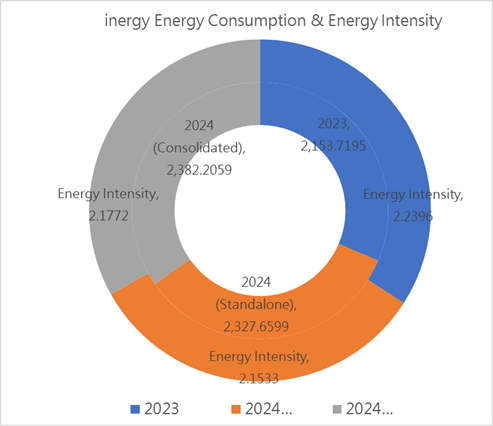
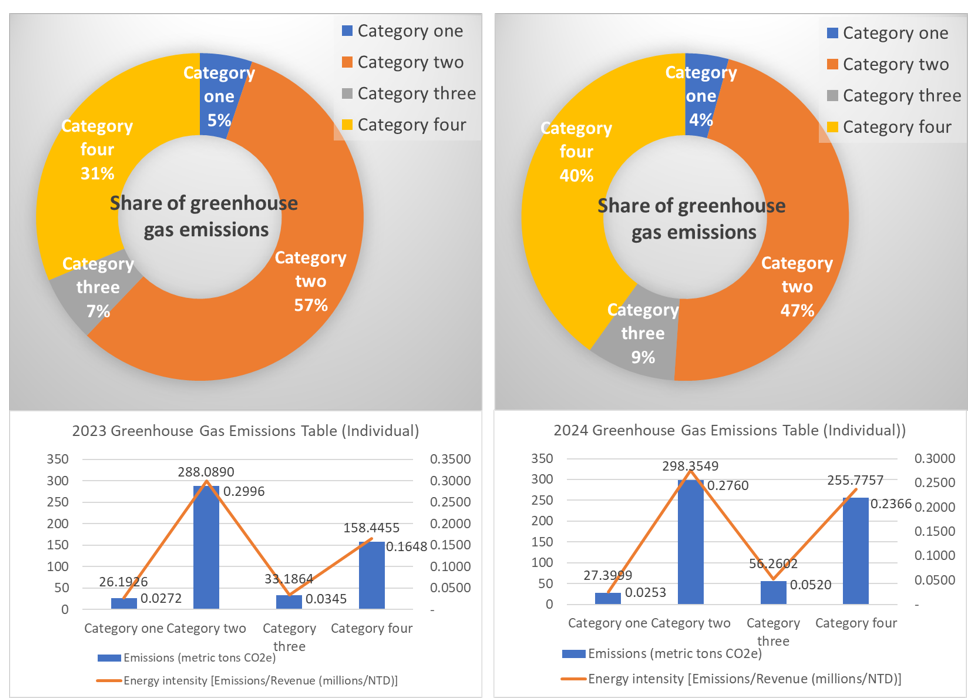
To manage energy consumption across inergy Technology’s upstream and downstream value chain, we began identifying significant external operational activities in 2024. This assessment was based on four key dimensions: external disclosure requirements, quantitative methodology, accessibility of emission factors, and the company's degree of control. > In 2024, our energy intensity—covering purchased goods and services, capital goods, fuel- and energy-related activities, upstream transportation and distribution, waste generated in operations, business travel, and employee commuting—was 0.3058 (tCO2e / per million TWD revenue). Among these, Category 4 (Purchased Goods and Services) accounted for the largest share, representing 38.2% of our total value chain energy consumption, with other categories making up the remaining 11.8%. Consequently, our future energy-saving initiatives will focus on collaborating with upstream suppliers to replace aging fuel-based transport equipment with electric vehicles (EVs) and renewable energy solutions.
Water Resources Management
As a fabless IC design company, inergy Technology outsources all manufacturing processes. Consequently, we do not utilize process water; our water consumption is limited to R&D testing and domestic usage at our office in Tai Yuen Hi-Tech Industrial Park. As the office lacks independent meters, water usage and fees are prorated based on floor area. 100% of our water is sourced from the Taiwan Water Corporation (Third-party water). The industrial park is equipped with sewage reclamation systems; domestic wastewater is treated and primarily recycled for landscape irrigation. All wastewater is discharged through building pipelines to the park's treatment facilities, ensuring no significant environmental impact.
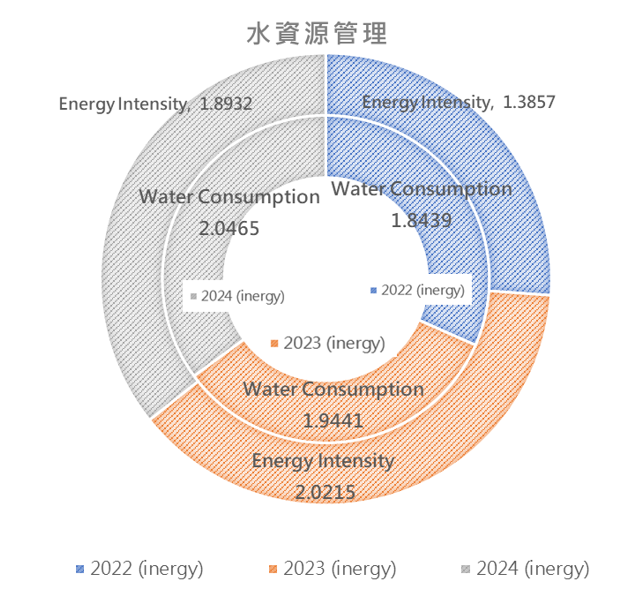
In 2023, our total water consumption was 1,944.10 cubic meters (m³). To prevent waste, all faucets, toilets, and urinals in our building are certified with Water Efficiency Labels and feature sensor-activated outlets adjusted for optimal flow. We also conduct regular water-saving advocacy.
Based on our water risk and impact pathway assessments, we have established management policies to mitigate risks and environmental impacts. Our strategies are evaluated to ensure they do not increase greenhouse gas emissions or energy consumption. Key measures include:
1. The water used by inergy Technology in Tai Yuen Hi-Tech Industrial Park is all domestic water. The park is equipped with sewage reclamation equipment; after domestic sewage is reclaimed, it is used for plant irrigation in the park. Domestic sewage is discharged to the sewage treatment equipment in the park for treatment before being discharged, which will not have much impact on water sources.
2. The faucets, toilets, and urinals used in the office building are all products with Water Efficiency Labels, and the water output is sensor-based, adjusted to the most suitable water volume to avoid wasting water resources.
3. Regularly conduct water-saving measure advocacy to reduce water resource consumption. Regularly inspect pumps, water towers, faucets, or other water pipe joints, as well as walls or underground pipelines for leaks.
4. Water consumption in 2024 increased by 5.3% compared to 2023. The main reason was the increase in domestic water consumption caused by the increase in the number of employees, so the water reduction target was reset.
5. Reduction targets:
2025-2026: Reduce water intensity by 1%.
2030: Mid-term reduction of water intensity by 2%.
| Year | Total Water Consumption (Unit : kWh) | Water Intensity |
|---|---|---|
| 2024 | 2,046.50 | 1.8932 |
| 2023 | 1,944.10 | 2.00215 |
Waste Management
inergy Technology will ensure that all staff strictly follow waste and recycling practices to enhance resource recycling and minimize general household waste, thereby reduing resource consumption.
| Year |
Hazardous Industrial Waste (Unit: Metric Tons) |
Non-hazardous Industrial Waste (Unit: Metric Tons) |
Total Weight of Waste (Unit: Metric Tons) |
|---|---|---|---|
| 2024 | 0.2594 | 6.2493 | 6.5087 |
| 2023 | 0.2090 | 1.8383 | 2.0473 |
| 2022 | 0.5264 | 0.1930 | 0.7194 |
Objectives And Indicators
- Greenhouse Gas (GHG) Emissions:
-
-
inergy Technology established 2023 as our base year. Following the international ISO 14064-1:2018 standard, we completed the 2023 GHG inventory with an organizational boundary covering the company (excluding subsidiaries).
-
GHG emissions in 2024 showed an increase over 2023 levels. This was primarily due to expanding the inventory boundary to include subsidiaries, alongside business expansion and increased production and R&D activities, which led to higher equipment electricity usage. Consequently, we have reset our GHG reduction targets.
-
We disclose GHG inventory results annually, set improvement goals, and conduct year-by-year reviews of our carbon reduction performance.
-
Reduction Goals: Reduce GHG energy intensity by 1% between 2025 and 2026, and by 3%–5% by 2030.
-
- Energy management:
-
-
We implement regional lighting controls in the office, with lights timed to shut off for 30 minutes during lunch breaks.
-
We promote a "power-off when not in use" policy for air conditioning and lighting in office environments and public areas. Indoor temperatures are maintained at 26–28°C to minimize energy waste.
-
With 2024 as our base year, inergy Technology incorporates high-efficiency standards into our internal energy management and planning for future equipment replacements. Our goal is to reduce energy intensity by 1% in 2025.
-
- Water Resource Management:
-
Located in the Tai Yuen Hi-Tech Industrial Park, inergy Technology consumes only domestic water. The park features sewage reclamation systems that recycle domestic wastewater for landscape irrigation. All sewage is treated by the park’s specialized facilities before discharge, ensuring minimal impact on local water sources.
-
We actively promote water conservation by installing water-saving devices on facilities. For equipment upgrades, we prioritize faucets with "Water Efficiency Labels." We also conduct regular inspections of pumps, water towers, and piping systems to proactively prevent leaks.
-
Water consumption in 2024 increased by 5.3% compared to 2023, primarily due to an increase in headcount. As a result, we have updated our reduction targets.
-
Reduction Goals: Reduce water intensity by 1% during 2025–2026, and a mid-term reduction of 2% by 2030.
- Waste management:
-
-
Our vision centers on a "zero-waste" resource cycle, emphasizing source reduction, reuse, material recycling, and energy recovery. We strive to maximize resource efficiency and minimize environmental impact through sustainable material circulation.
-
We are committed to increasing waste recycling and reuse rates while promoting reduction policies to enhance resource circulation.
-
We encourage the use of eco-friendly tableware and aim to reduce the use of disposable items.
-
Reduction Goal: Reduce waste intensity by 2% within the next three years.
-